
For most of my ministry I have given little thought to plagiarism. I
actually called a publishing house and asked if I could copy an outline
from an Old Testament Commentary and they said; "sure no problem." It
was not until Robyn and I wrote a couple of books and our material was
used without crediting us that it really hit me. Plagiarism has always
been a problem in this world and also in the Christian world. It has
legal and ethical ramifications. Authors work hard and long on writing a
book and editors do the same in making it fit for being published. So
please if you use the material credit the writer or preached.
 |
| From Matt Perlman |
From this point in the article the material is directly taken from
Matt Perlman.
The essence of plagiarism is to give the impression that the ideas or
words of another person are actually your own. This can be done
intentionally (in which case it is outright theft) or unintentional
but either way it is wrong.

The tenth edition of
Merriam Webster's Collegiate Dictionary
formally defines the term "plagiarize" from three different angles:
1. "To steal and pass off (the ideas or words of another) as one's own"
2. "To use (a created production) without crediting the source"
3. "To commit literary theft: present as new and original an idea or product derived from an existing source"
In a nutshell, you have committed plagiarism whenever you use another
ideas or words without crediting or acknowledging the source
Committing Plagiarism

We can spell this definition out more concretely. There are basically three ways in which plagiarism can be committed:
1. Quoting someone else word for word but not crediting them as the source.
2. Paraphrasing another's words without acknowledging the author whose
words you are restating. In other words, if you do not quote the person
verbatim but instead just change a few words and do not give credit, you
have committed plagiarism.
3. Using the ideas of another without acknowledging their source. Hence,
even if you state another person's ideas entirely in your own words,
you still must credit them as the source of the ideas. The only
exception is when the idea is well known and has become common
knowledge. For example, if I state that "it is 93 million miles to the
sun," I do not need to cite a source. It is common knowledge.
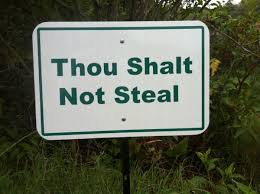
The Problem With Plagiarism
The central problem with plagiarism is twofold: (1) it is stealing; and
(2) it bears false witness. Obviously, both of these are unacceptable
for Bible-believing Christians (see Exodus 20:15; Mark 10:19; Matthew
15:19, etc). Stealing and bearing false witness fail to love your
neighbor as yourself (Romans 13:9). The words and ideas of another
person are precisely that—their words or ideas.
To fail to acknowledge their source is to give the false impression that
they have originated with you. Hence, plagiarism steals from another
and gives a false impression to your audience. Both of these factors
should be of utmost concern to the Christian, and especially pastors and
teachers who should have the utmost respect for the sanctity of truth.
Overcoming Plagiarism in Preaching and Teaching
1. It is not hard to avoid plagiarism. All that you have to do is
acknowledge the source whenever you quote, paraphrase or use the ideas
expressed by another. But, of course, life almost always throws us
complex situations where it is not clear how to apply a general
principle such as this. Hence, it will be helpful to spell out some
specific guidelines.
2. Detailed bibliographic data is not necessary. It is
not necessary to give detailed information as to the page number,
publisher of the book, date of publication and so forth when attributing
a source in a sermon. It is helpful to do this in papers, but even then
the absolutely necessary thing is to name the person from whom you got
the idea or quote, and if possible the specific book or lecture or
article.
3. Common knowledge does not need to have its source cited.
"Common knowledge" does not necessarily mean that everyone in your
audience knows the information. What is it then? The Purdue University
English Department suggests helpful criteria. You have "common
knowledge" when (1) "You find the same information undocumented in at
least five other sources"; (2) "You think it is information that your
readers will already know"; (3) "You think a person could easily find
the information with general reference sources" (
source).
Hence, "Jonathan Edwards was born in 1703" is common knowledge. "God is
most glorified in us when we are most satisfied in him" is not common
knowledge.
4. If the original source simply cannot be found, it is acceptable to say "As someone has once said…" (Most sources, however, can be found. For online searches,
www.google.com is indispensable. You might also try the new "Search
Inside the Book"."


 Quotes Worth Quoting

 If you would like to sign up, please go to the link below. If pre-registered, you may pay online or by check.


